Category: Uncommon Management

  • 3 Strategic Leadership Tools When Starting a New Job

    3 Strategic Leadership Tools When Starting a New Job

    CONGRATULATIONS! You got the offer! You accepted! Woo Hoo!!!

    Ready to fling yourself headlong into the new work and show them how awesome you are? Not so fast, Buckaroo! While most of us overachievers can’t wait to get our greedy little schedules booked up with onboarding, meet and greets, department overviews and project ramp ups, the very best thing you can do right out of the gate is SLOW DOWN!

    Counterintuitive? Yes. Counterproductive? No. Go SLOW (at first) in order to go FAST (when it counts). Check out these three tools to see what I mean.

    Schedule Self Care

    You KNOW yourself. You love your work, you love helping people and you love being busy so you are going to say “yes” to every single request that even thinks about coming your way. You will be woefully overbooked by day three, the dog will be whimpering to “please for the love of all that is good and right in the world let me out” while you “just wrap this one more call up”. You’ll be mere steps from your own refrigerator in your own kitchen in your own home and you will be relegated to snacking on crumbs picked from the couch cushions in your “home office” because this particular colleague is in really desperate need of specifically your advice for just a little while longer. Self care is necessary. Powder room visits are necessary. Your brain needs time to recoup and refresh. Strategic leadership takes time and space and thought. Slow down and schedule time for self care NOW before your schedule gets so tight you need WD-40 in order to get up and get the mail. And by self care I mean a daily bathroom break, some lunch, a vacation and a weekly 30 minutes for you to think strategically about your work, your role and your contribution.

    Prepare to Speak “CEO”

    You were selected because you ROCK. You said all the right things, had all the right creds and wowed them with all your innovative ideas. Now, you need to put all that awesomeness aside, become an empty vessel of nothingness and prepare to receive enlightenment. It’s all very Zen. In order to prepare to speak CEO (or whatever you feel comfortable calling your leader) you must lay aside your assumptions, lay aside your ideas and put on your listening ears on. What are the top challenges facing the org (team) right now? What one thing, if changed, would make the biggest positive difference? What have they tried so far to address the challenges? What do they want to try next? What’s their favorite part of leading this place? What parts do they hate? What kind of support can they rely on for the parts they hate so they can do more of what they love? Slow down and ask some questions. Listen to the answers. See the world from your leader’s point of view. Prepare to align your awesomeness with your leader’s world view so you can speak her language when it comes time for your proposals.

    Set Strategic Goals

    You already know how to do long term planning. You likely have a sense of what your role or department or function could look like a year from now based on what you know so far about the place. I’m not talking about those goals. I’m talking about YOUR goals. Who do YOU want to be? Why is achieving that important to you? What are the implications of achieving it? Are you willing and able to make the tradeoffs? Slow down and give purposeful thought to how you want to show up in this world, in this new organization in this new role and in your life.

    Enjoy the ramp up of your new gig. I don’t know about you but every time I start something new I tend to want to fling myself into it. I hope you can take it slow and steady. Preserve time for strategic thinking and planning and for taking care of yourself. It matters. Not only for your wellbeing but for the folks who depend on you so they get the best you. Be Uncommon.

    Develop your strategic leadership skills, gain coaching & mentoring support and practice HR wellbeing with a membership to UPschool. Learn more below:


    UPschool - Strategic Leadership Development for Human Resource management & people managers.
    Learn more about becoming a member of UPschoolhttps://bit.ly/3eeJdDo

  • Tough Employee Performance Conversation?

    Tough Employee Performance Conversation?

    Managing employee performance is no joke. It’s hard and often managers find themselves good and stuck…

    Employee: *does the thing*

    You: “Hey, remember that the thing is done this way so that everything works right.”

    Employee: *does the thing again*

    You: “Hey, it’s really important that the thing is done this way so that everything works right.”

    Employee: *does the thing again*

    You are now inclined to: (Choose all that apply. Be honest.)

    • Fume that the employee is not respecting your authority
    • Hope the problem resolves on its own because you don’t want to have to be mean
    • Wonder if they know something you don’t know
    • Consult with your boss, your colleague, your HR person, your cat regarding how annoying it is
    • In front of the whole team yell loudly “Can someone help employee figure out how to do their job properly?”
    • At the next team meeting say “Hey, just a reminder that when we do the thing it needs to be done this way so that everything works right.”
    • Say in a one on one conversation “Hey, I’ve noticed this is the third time I’ve corrected your approach on this. What gives?”

    Look. Managing Employee Performance is Hard.

    Good performance management takes time, energy, focus, courage, fortitude, specificity, empathy, patience…I could go on. It’s true. It can be hard. But we tend to make it harder on ourselves as people managers and HR leaders than we have to.

    Spinach in Your Teeth

    Think about the friends you have who would tell you that you have spinach in your teeth – or one of those poppy seeds from the bagel breakfast meeting you both just came from. (Wistfully thinks of pre-pandemic breakfast meetings…OK FOCUS!) That friend sees the poppy seed. Knows that’s not how you want to show up. Takes you aside and says “Dude. Poppy seed. On your left. Top incisor. [Inspects] Yes! You got it. You’re good. This is performance management. It is embarrassing and anxiety causing – especially if there’s an urgent deadline or if there’s been a great deal of conversation with others without this important information since the bagel incident). It is also kind, helpful, specific, supportive and goal oriented.

    A Performance Management Format You Can Use

    • I’ve noticed (the current performance/behavior/attitude)
    • What we need is (the correct/better/more effective performance)
    • The current performance is impacting (quality/morale/credibility)
    • You need to close the gap (urgently/over time/by next Tuesday)
    • How can I help?

    A Tip for More Human (and Humane) Performance Management

    Get figuratively (and literally if it’s not super weird) on the same side of the table. A football or dance of tennis coach will sit down with the athlete on the same side of the table. The coach and the athlete together will then watch a video of the practice, discuss what they see, discuss what they hope to achieve and discuss how to close the gap. It’s a beautiful thing. Be like coach.

    Performance Management Guidance

    Hard to say what you need to say? Here is a toolbox (find below video) of actual words to use in all kinds of performance management situations and …

    Here is a mini coaching session on management. It’s free. No one should have to struggle to figure out management and human resources leadership but good mentorship is hard to find.

    Management Coaching Tips & Best Practices
    Mini management coaching session by Julie Lynch for HR Pros and People Managers.
    Watch here: https://bit.ly/2OmdXb1

    These are the kinds of awesome tools and approaches our members learn in UPschool and my goal is for you to be able to build the most confident, inspired and contributing version of yourself. Won’t you join us? Membership is half price through 2020. For year round management expertise, live coaching and resources join UPschool today.

  • In the Palm of a Manager’s Hand

    In the Palm of a Manager’s Hand

    Did you know you hold your staff’s livelihood in the palm of your hand?

    Consider your own manager for a moment; the person to whom you report. Given the economic impact of this pandemic, the recent closures of all but non-essential business, the rippling effects of so many millions of people still out of work – what do you think your manager is being asked to consider in terms of planning their department?

    So Many Management Options

    Your manager may be asked to consider all kinds of things to help keep the business running optimally, such as:

    • How quickly they can ramp back up once the shut down is lifted?
    • If they need to downsize, who would they need to retain?
    • If help is needed in other departments, who could they lend?
    • If working from home is required longer term, who on their staff can and can’t thrive?
    • If processes or products need to be modified who is best at change and innovation?
    • Who on the staff would excel at communication, organization, analysis, …

    How Well-Managed Are You?

    Of course, as you consider the range of questions business leaders are asking themselves, you likely can’t help but jump right to “how does this affect me?”.

    And if your manager hasn’t spoken to you in a while or if you hear that your teammates have had one on one conversations and you haven’t or the last few conversations you HAVE had were about things you need to improve on – how comfortable do you feel as an employee? How productive, focused, passionate or enthused are you about the work ahead?

    How Well Are You Managing?

    Now consider your own direct reports. What might each of them be thinking? Are you certain that they know where they stand? Are they clear as to whether they are a valued star, a hopeful work in progress or an “on thin ice” distraction? Are YOU clear?

    What can you do right now to ensure your employees understand the bigger picture, see how their performance contributes to or distracts from it and remain passionate about their next steps with your organization?

    Management Guidance

    Here is a mini coaching session on management. It’s free. No one should have to struggle to figure out management and human resources leadership but good mentorship is hard to find.

    Management Coaching Tips & Best Practices
    Mini management coaching session by Julie Lynch for HR Pros and People Managers.
    Watch here: https://bit.ly/2OmdXb1

    These are the kinds of awesome tools and approaches our members learn in UPschool and my goal is for you to be able to build the most confident, inspired and contributing version of yourself. Won’t you join us? Membership is half price through 2020. For year round management expertise, live coaching and resources join UPschool today.

  • Managers: Stop Solving Employee’s Problems

    Managers: Stop Solving Employee’s Problems

    How many problems did you solve today? Or if it’s before 10am, how many did you solve yesterday? If you’re a manager worth your salt, you probably solved a couple few ammiright?

    How did it feel? Did you feel the little pump of dopamine even as you read the subject line? Did you think to yourself with anticipation and wry amusement “now, what did those colleagues get themselves into now?” Did your lizard brain – the one that reacts before you react – rub its scaly paws (paws?) together in anticipation of a cluster tangled up good and tight? Because you know that’s what you’re born for. It gets your blood going and the adrenaline singing and makes you perch on the edge of your seat.

    Why Managers Like Solving Problems?

    As managers problems are almost always an opportunity to get our needs met. We likely got the job of manager because we were good at solving problems and even more likely because we were good at helping other people solve their problems. What does that have to do with our own personal needs? Plenty!

    We All Have Needs

    According to the emotional intelligence experts and neuropsychologists out there, we human beings come ready made with a set of needs that evolve with us over our lifetime as a result of our nature and nurturing. While we all have a built in need for basics like sustenance and a sense of safety, we each have more nuanced needs like a need for freedom, control, to be heard or to be right. Each of us has a unique set so while I don’t know what yours are, I’ve worked with enough managers to know that many of us get ours satisfied through problem solving.

    Satisfying Our Needs

    What’s so satisfying about problem solving? Ahh let me count the needs… I’ll take myself for example. Some of my needs are for personal power (initiative taking), to be recognized, to be heard and to be respected. When someone comes to me with a question, they might just as well have brought me a blueberry cheesecake. I get to exert initiative, enjoy being sought out, relish talking through potential solutions and bask in the acknowledgment from others that I was a help. See? Just like eating cheesecake. But instead of satisfying my sweet tooth, it’s satisfying my ego.

    What’s So Bad About Solving Problems?

    If you’re the only one who can answer a particular question of untangle a particular cluster, there is absolutely nothing wrong with going ahead and indulging. However, if you are robbing someone of their opportunity to learn, stretch and develop by answering them instead of coaching well then, you’ve just taken a piece of cheesecake that wasn’t yours to have. And if you’re complaining about not having enough time or staff or bandwidth to get the big stuff done at the same time you’re swiping other people’s cheesecake, well then…you’re missing out on your chance to lead a bigger badder stronger cheesecake-eating team.

    Stop Stealing Cheesecake

    Want to become a better manager AND find out what the heck I’m talking about? Download Uncommon Consulting’s Manager’s Magic Potion™ below:

    Uncommon Consulting’s Manager’s Magic Potion™ is now available as a free download. For year round management expertise, live coaching and resources join UPschool today.

    Management Training & Development
    Saves time, develops employees & relieves stress. Download free introduction here: https://bit.ly/2ZZL1vd

    For year round management expertise, live coaching and resources join UPschool today.

  • The Manager’s Role is No Joke

    The Manager’s Role is No Joke

    Most of us who end up with a people manager role know that the job entails planning, budgeting, staffing, leading and evaluating. But did you know that managers are agents of the company which means that what you say/email/text is considered to be what the company has said/put in writing? Did you know that you can be held personally liable in some states for something you “should have known” was happening in the organization? Did you know that a manager assuring an employee that they will “always have a job here” can be considered an implied contract?

    Managing virtually? Did you know…

    Now that so many managers are managing virtually we have even more concerns to be aware of. It is the manager’s responsibility to ensure employees are working appropriate hours, taking required breaks and documenting time off – even if all our time is at home. How do we make sure we’re doing all that?

    It’s our responsibility to ensure employee’s have safe working conditions, have access to the resources they need to do their job and are treated equitably.

    It is up to us as managers to ensure we’re communicating the overarching mission and vision of the organization and translating that into actionable goals among the roles that report to us.

    It’s a lot.

    How Are You Managing?

    What support do you have to ensure that you are not only compliant but communicative? Not only informative but inspirational? Not only meeting expectations but building excellence? There are a number of resources at your disposal:

    • Your company’s employee handbook – if it is up to date – should have all the basics of employee policy and procedure covered. This is where you’ll find things like how much time employees can take off for what kinds of reasons. How many breaks they should have and for how long. What the processes are for requesting a leave or documenting sick days. And more.
    • Your own manager can provide direction in terms of overarching goals and senior management expectations.
    • Your Human Resources department should be able to refer you to internal and external resources for people management practices.
    • Your management colleagues can be a good source of information and support.
    • A google search can point you to a plethora of people management tips, courses and training from free to exorbitant.

    The important thing, if you are a manager of people, is that you find trusted information and guidance. Because if you think about your own best and worst managers and how they impacted your ability to do your best work, you’ll quickly be reminded of how important it is to do that job well.

    Management Guidance

    Here is a mini coaching session on management. It’s free. No one should have to struggle to figure out management and human resources leadership but good mentorship is hard to find.

    Management Coaching Tips & Best Practices
    Mini management coaching session by Julie Lynch for HR Pros and People Managers.
    Watch here: https://bit.ly/2OmdXb1

    These are the kinds of awesome tools and approaches our members learn in UPschool and my goal is for you to be able to build the most confident, inspired and contributing version of yourself. Won’t you join us? Membership is half price through 2020. For year round management expertise, live coaching and resources join UPschool today.

  • Performance Management During Today’s Reality

    Performance Management During Today’s Reality

    Don’t we have enough going on without having to plan an uncomfortable sit down with a staff member about poor performance? Yes, we most certainly do. However that is no excuse for not letting someone know that their performance is suffering and needs correction. The time for performance management is now.

    Waiting Creates Risk

    When we wait to give critical feedback we open the person, the team and the organization up to unnecessary risk. Without the feedback, the person will build the wrong habits and make them that much more difficult to break. Without correction, the team will see that bad habits, inaccuracies or poor quality is accepted for some people or in some cases which can damage morale and erode pride in workmanship. Without documentation of concerns, organizational liabilities can increase in the form of higher operational, legal and employment costs.

    Make the Job Easier

    As uncomfortable and inconvenient as it is, the job of performance management is the job to be done so here’s a way to make a smooch easier:

    • You: Hey Julie I noticed you looked like you were working on something else during the zoom call. Everything ok?
    • Julie: Oh, uh, yeah – that project you asked me to do.
    • You: I’m glad you’re on top of that – it’s important. It’s just as important to look engaged in our team meetings though so in future if you can avoid multi-tasking, it will help you build more credibility with the team and our speakers.

    Immediate, genuine, supportive, confident guidance. This is the job.

    Performance Management Guidance

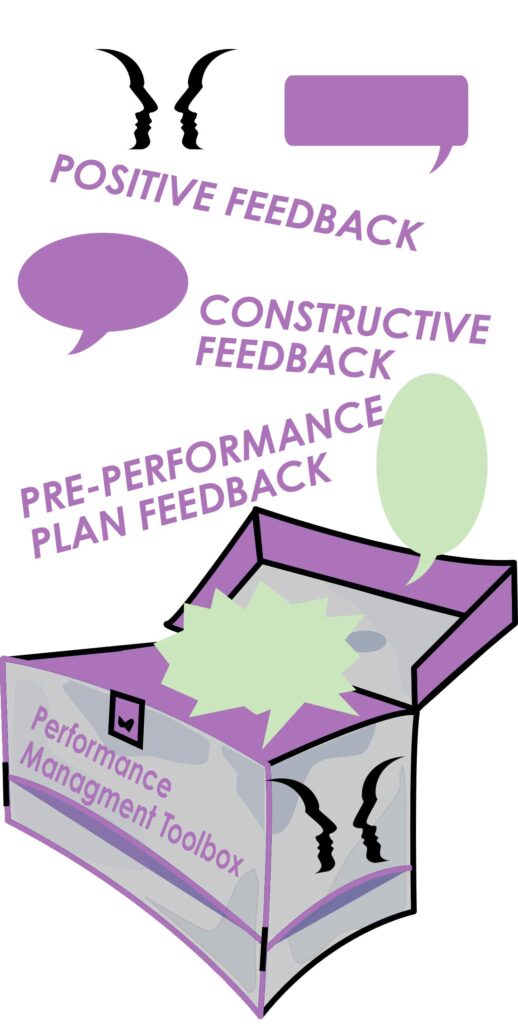
    Hard to say what you need to say? Download a toolbox of actual words to use in all kinds of performance management situations. No one should have to struggle alone with these conversations and employees deserve to hear where they stand.

    DOWNLOAD the Performance Management Toolbox here

    These are the kinds of awesome tools and approaches our members learn in UPschool. Won’t you join us? Membership is now half price. For year round management expertise, live coaching and resources join UPschool today.

  • No Time to Manage Employees?

    No Time to Manage Employees?

    A lack of time is the number one reason managers will give as the reason they are unable to manage their employees / direct reports as well as they’d like. Setting goals, providing direction, coaching on progress, providing feedback, celebrating wins and offering corrective guidance is, quite literally, a full time job. Most managers, however, already have a full time job so this stuff gets relegated to the edges if at all.

    More Time Working from Home?

    So here we are nearly five months into a work-from-home protocol where many of us have no commute, presumably a shorter walk to the washroom and fewer colleagues stopping by our desk to chat about the weather. You would think we’d have just a teensy bit more time on our hands. But alas those time savers have likely been eaten up.

    Putting in the Time Gets Results

    Ok, so we probably don’t have a whole lot more spare time. But we know, rationally, that if we spent a few more minutes upfront being clear about expectations that we would save hours on the back end not having to unravel the misalignments. And we know in our heart of hearts that if we took the time to say what we actually thought about the mediocre performance being demonstrated that the offending performer might shape up or ship out thereby saving all kinds of time currently spent re-working, re-directing and re-banging our head against the wall in frustration. And we definitely believe that taking the time to let a team member know how invaluable their contribution was to that important project we completed last week increases the likelihood that the team member – who is a star by the way – is less likely to quit when they find an offer that seems to better appreciate what they do.

    Time is Not the Problem

    The thing is, I don’t think it’s truly a matter of not having enough time. It’s the fact that managing is hard and – if you’re doing it right – makes your stomach queasy and it’s easier to put it off when there are more pressing and less awful things to spend our time on. But that’s not your job. Your job is to manage employees and that requires having meaningful conversations of substance with each of your direct reports on a regular basis about their performance, their accomplishments and their connection to your organization.

    It’s Time to Connect. It’s Time to Manage.

    Quick! Pick up the phone, open FaceTime or boot up a meeting on Zoom and connect with your employee. Here’s a guide: Say hello. Ask how they’re doing. Acknowledge this is an unusual time. Ask if there is anything they need. Acknowledge some stuff you are struggling with/had to solve (noisy home, no work desk, spouse working at home too, etc.). Let them know you’re available if they need anything. Thank them for being there and contributing what they can right now. Say good bye and wish them a good evening.

    Want to Really Save Time?

    Want to save time AND become a better manager? Uncommon Consulting’s Manager’s Magic Potion™ is now available as a free download.

    For year round management expertise, live coaching and resources join UPschool today.

    Management Training & Development
    Free Download
    https://bit.ly/2CedMMr