You know that manager who is just the sweetest? Just got promoted. Has been so good at their individual contributor job. Now asks all sorts of questions about managing and really seems to appreciate HR’s advice? That manager needs training.
You know that manager who is just awful? the one who is always saving the company’s skin with extra revenue or extra savings but whose employees are constantly complaining to HR about how they are treated? The one who is totally uninterested in even looking at the HR team members never mind speaking to them or hearing what they might have to say? That manager needs training.
You know that manager who is so quiet we almost forget they’re there? The one who always returns their paperwork on time and who’s employees don’t say a peep? That manager needs training.
Liability
Those managers are liabilities. Too new to know, too seasoned to second-guess, too dedicated to complain yet all of them are making an impact on their employees and colleagues with their words and actions. All of them are agents of the company. All of them are a liability if they say or do something that is illegal or against company policy. But to focus on that would be a shame. To focus defensively, preemptively, warily, distrustfully would be reminiscent of “bad” HR and we’re better than that.
Innovation
Those managers are wellsprings of innovation: new enough to see the possibilities, Seasoned enough to cross train others, dedicated enough to contribute to policy and process improvements. All of them are agents of the company. All of them can be assigned goals related to innovation and collaboration. And to focus on this would be a boon. To focus purposefully, proactively, optimistically and trustfully would be uncommonly good HR and we’re all about that.
Be uncommon.
Uncommon Consulting’s Manager’s Magic Potion™ is now available as a free download. For year round management expertise, live coaching and resources join UPschool today.
How many problems did you solve today? Or if it’s before 10am, how many did you solve yesterday? If you’re a manager worth your salt, you probably solved a couple few ammiright?
How did it feel? Did you feel the little pump of dopamine even as you read the subject line? Did you think to yourself with anticipation and wry amusement “now, what did those colleagues get themselves into now?” Did your lizard brain – the one that reacts before you react – rub its scaly paws (paws?) together in anticipation of a cluster tangled up good and tight? Because you know that’s what you’re born for. It gets your blood going and the adrenaline singing and makes you perch on the edge of your seat.
Why Managers Like Solving Problems?
As managers problems are almost always an opportunity to get our needs met. We likely got the job of manager because we were good at solving problems and even more likely because we were good at helping other people solve their problems. What does that have to do with our own personal needs? Plenty!
We All Have Needs
According to the emotional intelligence experts and neuropsychologists out there, we human beings come ready made with a set of needs that evolve with us over our lifetime as a result of our nature and nurturing. While we all have a built in need for basics like sustenance and a sense of safety, we each have more nuanced needs like a need for freedom, control, to be heard or to be right. Each of us has a unique set so while I don’t know what yours are, I’ve worked with enough managers to know that many of us get ours satisfied through problem solving.
Satisfying Our Needs
What’s so satisfying about problem solving? Ahh let me count the needs… I’ll take myself for example. Some of my needs are for personal power (initiative taking), to be recognized, to be heard and to be respected. When someone comes to me with a question, they might just as well have brought me a blueberry cheesecake. I get to exert initiative, enjoy being sought out, relish talking through potential solutions and bask in the acknowledgment from others that I was a help. See? Just like eating cheesecake. But instead of satisfying my sweet tooth, it’s satisfying my ego.
What’s So Bad About Solving Problems?
If you’re the only one who can answer a particular question of untangle a particular cluster, there is absolutely nothing wrong with going ahead and indulging. However, if you are robbing someone of their opportunity to learn, stretch and develop by answering them instead of coaching well then, you’ve just taken a piece of cheesecake that wasn’t yours to have. And if you’re complaining about not having enough time or staff or bandwidth to get the big stuff done at the same time you’re swiping other people’s cheesecake, well then…you’re missing out on your chance to lead a bigger badder stronger cheesecake-eating team.
Stop Stealing Cheesecake
Want to become a better manager AND find out what the heck I’m talking about? Download Uncommon Consulting’s Manager’s Magic Potion™ below:
Uncommon Consulting’s Manager’s Magic Potion™ is now available as a free download. For year round management expertise, live coaching and resources join UPschool today.
Think about a time you shared a concern, complain or frustration with someone and they responded with something along the lines of “Oh! You need to talk to so and so…” or “that happened to me and what I did was…” or “Have you tried x, y, and z…?
Of course you don’t. Of course it didn’t. Of course you did. 9 times out of 10 they have jumped in after just a surface understanding of your issue having made a tenuous connection to their own experience and, fueled by an overriding need to be helpful/smart/efficient/done with the conversation, have provided you with the answer to what they think is your question.
You probably do this too. It’s not a bad thing necessarily. It’s just that, as managers, we get pulled into a lot of these kinds of conversations and they can do more damage in terms of wasted time or poor advice, than doing nothing at all.
What managers can do:
Before you start to answer, invite them to tell you more. “Tell me more about the situation” “What else can you tell me?” “Give me more context” “What have you tried so far?” “What would be most helpful?” Are all great questions to elicit more information and context so that if you are still moved to provide advice, it will be more relevant given the unique circumstance being experienced by the advisee.
2. Your advice is what YOU would do, not what THEY would do.
Your advice may completely resonate with – and even excite and enthuse – the person seeking help. But your experiences, perspectives, strengths, weaknesses and motivations are your own and your actions and ideas are borne out of that background. When they go to implement your suggestion it often becomes strikingly clear that while they’d like to, they are not equipped to. This can stall or prevent forward movement.
What managers can do:
Consider using a coaching approach as opposed to a consultative approach. Guiding the advisee to construct options from their own experience can produce more feasible actions which they are better equipped to take. Ask questions like “What next steps might make sense?” “How have you handled this kind of thing in the past?” “What part of this is most challenging?”
3. They are not looking for your advice.
Sometime peoples are just sharing some stuff. They’re letting you know what they’re dealing with or sharing a frustration or getting validation on how they’re feeling. They also may be looking to present the issue at hand AND how they are planning to deal with but they get hijacked by the well-meaning advisor before they’re able to finish their thought.
What managers can do:
Resist the urge to jump in and solve. Ask “how can I help”? Right up front and find out what they’re hoping for. They’ll have the opportunity to say “I need your help/advice” or “I want to run something by you” or “I know what I want to do I just need permission.” Or something else that provides some good direction for how you can shape how you spend your time and attention.
Want to save time AND become a better manager?
Uncommon Consulting’s Manager’s Magic Potion™ is now available as a free download. For year round management expertise, live coaching and resources join UPschool today.
A lack of time is the number one reason managers will give as the reason they are unable to manage their employees / direct reports as well as they’d like. Setting goals, providing direction, coaching on progress, providing feedback, celebrating wins and offering corrective guidance is, quite literally, a full time job. Most managers, however, already have a full time job so this stuff gets relegated to the edges if at all.
More Time Working from Home?
So here we are nearly five months into a work-from-home protocol where many of us have no commute, presumably a shorter walk to the washroom and fewer colleagues stopping by our desk to chat about the weather. You would think we’d have just a teensy bit more time on our hands. But alas those time savers have likely been eaten up.
Putting in the Time Gets Results
Ok, so we probably don’t have a whole lot more spare time. But we know, rationally, that if we spent a few more minutes upfront being clear about expectations that we would save hours on the back end not having to unravel the misalignments. And we know in our heart of hearts that if we took the time to say what we actually thought about the mediocre performance being demonstrated that the offending performer might shape up or ship out thereby saving all kinds of time currently spent re-working, re-directing and re-banging our head against the wall in frustration. And we definitely believe that taking the time to let a team member know how invaluable their contribution was to that important project we completed last week increases the likelihood that the team member – who is a star by the way – is less likely to quit when they find an offer that seems to better appreciate what they do.
Time is Not the Problem
The thing is, I don’t think it’s truly a matter of not having enough time. It’s the fact that managing is hard and – if you’re doing it right – makes your stomach queasy and it’s easier to put it off when there are more pressing and less awful things to spend our time on. But that’s not your job. Your job is to manage employees and that requires having meaningful conversations of substance with each of your direct reports on a regular basis about their performance, their accomplishments and their connection to your organization.
It’s Time to Connect. It’s Time to Manage.
Quick! Pick up the phone, open FaceTime or boot up a meeting on Zoom and connect with your employee. Here’s a guide: Say hello. Ask how they’re doing. Acknowledge this is an unusual time. Ask if there is anything they need. Acknowledge some stuff you are struggling with/had to solve (noisy home, no work desk, spouse working at home too, etc.). Let them know you’re available if they need anything. Thank them for being there and contributing what they can right now. Say good bye and wish them a good evening.
As a manager, are you constantly barraged with questions from employees on what to do next or how to handle a situation? Are you hesitant to delegate to your team because you’re not sure your staff has the skills? Do you wish you had more headcount to handle the workload in your group? Are you looking for way to help develop employees? Here are a few things you can do today to make a difference.
1. The “Stop It” Exercise
This is a great exercise you can assign to all of your staff (and yourself) to assess the relative value of the work you are currently doing and to identify what work can be discontinued to free up precious time and resources. How to do it:
List all work – routine tasks, projects, reporting, meetings, etc.
Identify those items that are known to have critical/consequential impact (either within the team or for the organization). Identify ways to make these more efficient.
Identify those that have questionable impact, research their importance and move them to list A or B accordingly.
Identify those that are done “just because we’ve always done it”. Stop doing those.
A good way to force the thinking on this is to imagine that the team collectively decides to start a commune in Utah and leaves the organization. What work would be urgently re-assigned to others in the organization, what work would sit in a pile waiting for someone to take it over and what work would be deemed unnecessary in those circumstances.
Bonus Tipto help Develop Employees: Share the lists to increase understanding and appreciation of the whole team’s contributions and how each part depends on others to be successful. Have the team brainstorm any additional ways to streamline the work.
2. The Resume Review
If you haven’t already reviewed and discussed this information with each of your staff, you may be surprised to find resources and skill sets hidden right in your own team. How to do it:
Let your team know that you’d like to take a more concerted approach to employee development and aligning their skills and interests with the current and future work of the team.
Set up one on one meetings with each direct report and let them know you’d like to hear about what they most enjoy doing, what they’d like to do more of, what they’d like to learn/develop and what their long term hopes are for their career.
Ahead of your meetings, review your employees’ resumes/CVs to get a sense of past experiences/education that could be applied to current or future work.
Hold the meetings and listen.
Once you’ve held your meetings, gather your learnings and identify opportunities for delegation, training, task or project swapping for better skill set matches, etc.
Bonus Tip to Develop Employees: Share interesting backgrounds and skill sets with the whole team to increase appreciation for the diversity and depth available across colleagues.
3. Stop Solving Problems
If you are like most managers, you probably answer a lot of questions and solve a lot of problems. You need to stop that. You’re wasting time, preventing people from developing their own capability and missing opportunities to reward your stars for good thinking and initiative. When an employee asks a question or brings a problem to you – resist the urge to answer and, instead, consider having a developmental dialogue. Here’s how:
Good question! Tell me more about the situation.
Bring me up to speed, what have you tried so far?
If it were up to you, how might you handle next steps?
What challenges would you anticipate?
Holding a dialogue engages the employee in thinking through the problem, allows them to develop problem solving skills in a relatively safe environment and gives you the opportunity to recognize capability.
Want to save time AND become a better manager?
Uncommon Consulting’s Manager’s Magic Potion™ is now available as a free download. For year round management expertise, live coaching and resources join UPschool today.
Mark the stuff you LOVE to do and which you and only you can do with a “K” for keep.
Mark the stuff you HATE to do that only you can do with an “K” for keep.
Mark the stuff you LOVE to do and which others could do with a “L” for Let Go
Mark the stuff others could do with a “Y” for Yardsale.
Share entire list with staff and ask who would like what from the Yardsale pile or from the Let Go pile. Make the deal if there is a match between interest and (potential) skill set.
Delegate it. Teach them how. Allow an understudy. Do it like your job depended on it. Because it should.
Want to save time AND become a better manager?
Uncommon Consulting’s Manager’s Magic Potion™ is now available as a free download. For year round management expertise, live coaching and resources join UPschool today.
I will often start my management training programs by asking people to leave. Sometimes they think I’m kidding. But I take them through a quick and fun little exercise to determine whether they have more important things to do that will keep them from focusing on and participating fully and genuinely in the program. If they do, I invite them to leave with no harm done and no foul committed. For those who choose to stay, I invite them to let go of their to do list and commit fully to the program since, if they are distracted, they will neither learn not make progress on their to do list and that’s a lose – lose – lose for all of us: them, the participants, me, your company and your employees.
Great Management is Not Created the Same
What’s wrong with management training is that we treat it like a discrete body of knowledge that can be transferred in a day or two or seven; something we can learn and be deemed to know after having completed even a four year degree on the topic. This is not the case. There are three types of managers:
The New Manager – An enthusiastic, not-yet-competent-in-the-field professional eager to soak up like a sponge whatever they can get their hands on in order to do a decent job.
The Seasoned Manager – A self-confident liability to the company who feels they’ve been there, learned that and have way more important business issues of concern than further exploring management practices.
The Wise Manager – A self-aware contributor who knows that one could spend seven hundred lifetimes as a manager and still not encounter all the crazy issues human beings can present in the workplace.
Mistakes in Management Training
What’s wrong with Management Training is that we typically develop and deliver it for the first two types of managers and we fail to set the expectation for or hold managers accountable to becoming the third type. This is a mistake. When we present management training programs without explicitly setting expectations for what management (and leadership) entails and how specifically – and consequentially – people will be held accountable for those responsibilities, any training we do ends up being like speaking about the dress code: no one thinks you’re talking about them. The grown woman in the middle row wearing a crop top, pajama bottoms and a pair of rubber slides is looking around at all her colleagues nodding in solidarity with the HR person who is desperately trying to define business causal.
Individual, Situational and Accidental
Managers are individuals – each one uniquely unique. Some will be more drill sergeant-y, others more therapist-y and both – and all the types in between – can be successful. Management is situational – some contexts calling for tough love, others calling for TLC. Management is a practice that requires skill, knowledge, flexibility, continued education, discipline and humility. Strong managers are developed over time with practice and, in most cases, by accident.
What Do you Expect?
If your business outcomes are important to your leadership and those business outcomes require efficient and effective workforce performance, then setting clear and consequential expectations for the performance of your managers can go much further than hiring a trainer to talk at people while they answer their emails and blow sandwich crumbs out of their laptop keyboards.
Uncommon Consulting’s Manager’s Magic Potion™ is now available as a free download. For year round management expertise, live coaching and resources join UPschool today.
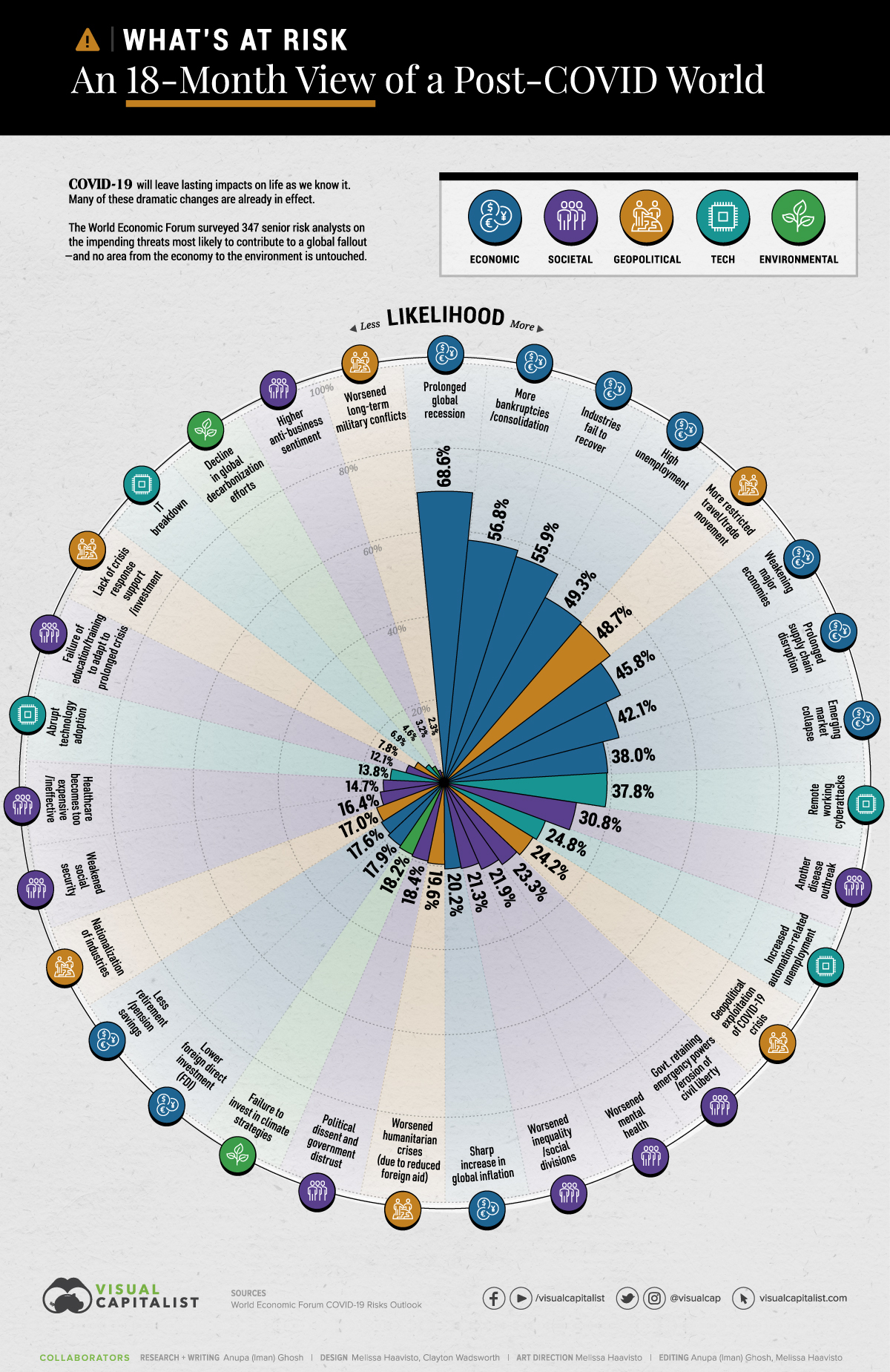
Well, this is sobering. This visual capitalist article lays out the anticipated near-, mid-, and long-term impacts of Covid 19 on our world and while the visual is impressive, the news ain’t pretty.
Strategic Human Resources
As strategic Human Resources leaders, our job is to seek out, understand and apply this information to our organizations. Not in a general “times are tough, it’s going to be rough, we’ll steel ourselves for the onslaught of HR needs” kind of way, but more in a “let’s analyze how these specific forecasts will affect our specific organization and how we will plan to specifically prepare our leadership, management and workforce to succeed despite the storm” kind of way.
HR Requires Strategic Thinking
Consider the implications outlined in the visual capitalist report and how they specifically relate to your organization. How recession prone/proof is your industry? How dependent is your company on global supply chains? What areas of the organization will be hardest hit by those factors and what skills sets will you require? If your organization offers a pension (there are still a few of you out there), what is the implication of fund devaluation and what can you do preemptively to respond?
Strategic Implications of Social Anxieties
Nine of the top 31 major risks identified are in the Societal category. Five of those are in the top 20 and ALL of those directly impact our workforce in terms of everything from culture, compliance, productivity and safety to benefits, compensation, training and more.
#10
Another global outbreak of COVID-19 or different infectious disease
30.8%
#13
Governmental retention of emergency powers and/or erosion of civil liberties
23.3%
#14
Exacerbation of mental health issues
21.9%
#15
Fresh surge in inequality and social divisions
21.3%
#18
Anger with political leaders and distrust of government
18.4%
Taking Strategic Action
At Uncommon Consulting we take a Workforce Efficacy™ approach to these complex concerns:
Constantly scan the business environment
Consider the specific implications of the environment on your org
Use Workforce Efficacy thinking to determine strategic implications
Consider what support each segment will require from HR
Make your case for those supports in the context of the strategic implications
This approach takes a big picture approach (the outermost ring of the nested circles in the image above) and stays centered on what matters most: What is our Mission and how is it helped/hurt in this context? How can it help/hinder our response? What are we on track to become (our Vision of our future), how is our progress toward that goal impacted in this context and what do we need to shore up or re-assess to stay on track in terms of our Strategy? What changes will we need to make with respect to Execution in terms of skills sets, deadlines, resources and structure? And, finally, what will our employees – at every level – need in order to contribute their very best Performance? What specifically will Leaders, Managers and Individual Contributors require in terms of skill sets and personal stamina to succeed and what is your plan to deliver those?
Make the Strategic Connection
Wellness programs and engagement initiatives are great. Diversity and inclusion statements are commendable. Of course they will have a benefit. But if you can’t make the case for how and why you see those efforts specifically and measurably contributing to the big picture, you shouldn’t be implementing them.
18 months is a long time. We’re in this for long haul. We’re running a marathon, not jumping rope.
In it Together
No one should have to navigate these big questions alone. Managing and leading with integrity and safety requires courage and support. Becoming the most confident, inspired and contributing version of yourself requires UPschool. Won’t you join us? Membership is half price right now. For year-round expertise, live coaching and resources for you personally and professionally join UPschool today.
Uncommon Consulting’s Manager’s Magic Potion™ is now available as a free download. For year round management expertise, live coaching and resources join UPschool today.